

Several members of Duke Pathology contributed scientific presentations, educational programming, and leadership activities at the American Association of Neuropathologists (AANP) 102nd Annual Meeting, held June 4-7, 2026, in Cambridge, Maryland.
Duke faculty, trainees, and research staff represented a broad range of expertise spanning neurodegenerative disease, neuro-oncology, neuromuscular pathology, and diagnostic neuropathology. Participants included Associate Professors Karra Jones, MD, PhD, Giselle López, MD, PhD, and Shih-Hsiu “Jerry” Wang, MD, PhD; Neuropathology Fellow Levi Endelman, MD; and Erin Connolly, research analyst for the Duke-UNC Alzheimer’s Disease Research Center (ADRC) Bryan Brain Bank.
National Leadership in Neuropathology Education
In addition to presenting research, Duke faculty played key leadership roles during the meeting.
Jones serves as chair of the AANP Education Committee and as assistant secretary-treasurer on the organization's Executive Council. Through her work with the Education Committee, she collaborates with AANP leadership to develop and deliver educational programming for the annual meeting and other professional activities.
López also contributed to the meeting's scientific program, serving as co-moderator of a platform session focused on glial tumors. Former Duke neuropathology fellow William Harrison, MD—now assistant professor of Pathology, Gerontology and Geriatrics, Internal Medicine, and Neurology at Wake Forest University School of Medicine—co-moderated a platform session on neurodegenerative diseases, including frontotemporal lobar degeneration (FTLD), Lewy body disease, and chronic traumatic encephalopathy (CTE).
Duke Research Featured in Platform Presentations

Duke investigators shared research findings and clinical insights through several platform presentations.
Neuropathology Fellow Levi Endelman, MD, under the mentorship of Jones, presented a challenging diagnostic case during the meeting's Diagnostic Slide Session. The case focused on checkpoint inhibitor-associated myositis, a rare but important immune-related adverse event associated with cancer immunotherapy. He was also selected for the AANP Scholars Program, a competitive initiative that provides financial support to outstanding trainees and early-career investigators.
Erin Connolly presented research titled, "Differential Labeling of Neurofibrillary Tangle Maturity by New Phospho-Tau Epitopes," highlighting ongoing efforts to develop new diagnostic markers to understand the full spectrum of Alzheimer’s disease pathology.

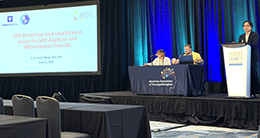
Wang delivered a presentation titled, "TDP-43 and Tau Seed Amplification Assays for LATE Diagnosis and Differentiation from AD," exploring ultra-sensitive methods to detect misfolded proteins from patient cerebrospinal fluid to to improve the diagnosis and distinction of two common age-related neurodegenerative disorders: Alzheimer’s disease and limbic-predominant age-related TDP-43 encephalopathy (LATE).
Jones also presented research on "Early Myopathology of Pompe Disease in Patients Detected by Newborn Screening," examining early neuropathological changes in a rare inherited metabolic disease and the implications of earlier disease detection.
Advancing Discovery and Collaboration
The breadth of Duke's participation at the AANP annual meeting reflects the department's continued commitment to advancing research, education, and clinical excellence in neuropathology. Through scientific presentations, trainee development, and national leadership service, Duke faculty and researchers are helping shape the future of the field while contributing to a deeper understanding of neurological disease.