
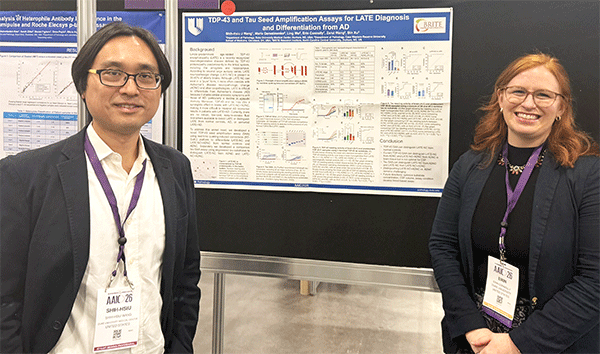
Shih-Hsiu “Jerry” Wang, MD, PhD, associate professor of Pathology and neuropathology core lead for the Duke-University of North Carolina at Chapel Hill Alzheimer's Disease Research Center (ADRC), and Erin Connolly, research analyst for the Duke Bryan Brain Bank, presented a poster titled “TDP-43 and Tau Seed Amplification Assays for LATE Diagnosis and Differentiation from AD” at the Alzheimer’s Association International Conference (AAIC), held July 12-15, 2026, in London.
Their research addresses a significant challenge in dementia care: distinguishing limbic-predominant age-related TDP-43 encephalopathy (LATE) from Alzheimer disease (AD). Both conditions commonly present with memory loss and other cognitive symptoms, making it tough to differentiate between them based on clinical evaluation alone. However, the diseases are driven by different underlying pathologies. LATE is characterized by the accumulation of misfolded TDP-43 protein in the brain, while Alzheimer disease is associated with the accumulation of beta-amyloid and tau proteins.
Accurate diagnosis remains a major obstacle for differentiating LATE from AD. Unlike Alzheimer disease, which has established biomarker tests and imaging approaches, currently there are no clinically validated methods to reliably detect misfolded TDP-43 through brain imaging, cerebrospinal fluid (CSF), or blood testing. As a result, many patients with LATE may go undiagnosed, limiting opportunities for therapeutic intervention.
Earlier this year, Wang and collaborators Bin Xu, PhD, of North Carolina Central University and Peter Nelson, MD, PhD, of the University of Kentucky College of Medicine published a review article in Acta Neuropathologica examining recent advances and ongoing challenges in the development of diagnostic biomarkers for LATE. Read the article here.
In this study, Wang and Xu’s research team developed a new TDP-43 seed amplification assay (SAA) designed to detect misfolded TDP-43 in CSF samples from patients with LATE. The assay uses the ability of misfolded TDP-43 "seeds" present in patient samples to trigger conformational changes and aggregation of laboratory-engineered TDP-43 proteins, amplifying the signal to detectable levels.
The researchers also evaluated how TDP-43 and tau seed amplification assays may work together to differentiate LATE from Alzheimer disease. If further validated, this approach could provide clinicians with a powerful new tool for identifying the specific disease processes driving a patient's cognitive decline.
"Reliable biomarkers for LATE could transform how clinicians diagnose dementia, enabling earlier identification of disease and better alignment of patients with future targeted therapies," said Wang.
The potential impact on patient care is substantial. Earlier and more accurate diagnosis could help patients and families better understand the cause of symptoms, improve prognostic counseling, and support more appropriate treatment planning. In the future, reliable TDP-43 biomarkers may also help researchers to enroll appropriate patients in clinical trials and speed the development of targeted therapies for LATE and related neurodegenerative disorders.
AAIC is the world's largest international conference dedicated to Alzheimer disease and related dementias. The 2026 meeting drew more than 13,000 attendees from over 100 countries, providing a global forum for sharing advances in dementia research, diagnosis, treatment, and prevention.