

Two PhD candidates from Duke Pathology’s Graduate Program in Pathobiology and Translational Biosciences were selected to present at the Duke Cancer Institute (DCI) Retreat on Dec. 4, 2025. Each received glass-etched memorabilia called “DCI 2025 Scientific Retreat Featured Research Presenter.”
Pathology PhD student Lucy Driver presented a talk titled “Protecting Against Gastrointestinal Acute Radiation Syndrome by Hippo Pathway Inhibition.” In her talk, she discussed a new drug her team has developed to help the gastrointestinal (GI) tract heal itself after radiation by reprogramming cells to regenerate. Radiation therapy is a powerful tool against cancer but it can also harm healthy tissues, especially in the digestive system. When the GI tract is damaged by high doses of radiation, it can lead to a dangerous condition called GI acute radiation syndrome (GI-ARS). To prevent this, researchers on her team are looking for ways to protect the gut without increasing cancer risk.
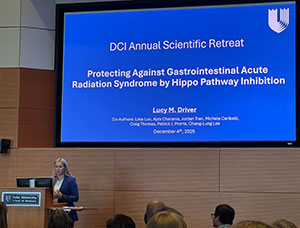
In studies with mice, this approach worked safely and effectively, even months after treatment, without causing additional injuries or cancer. These findings suggest that targeting specific proteins (called LATS1/2) could be a promising way to protect patients from severe radiation side effects in the future.
Driver is a part of Duke’s Radiation Oncology and Imaging Program, and a member of the Lee Lab.
Pathology PhD student Loren Weidenhammer gave a talk titled “ATAT1-Driven Acetylation as a Mechanism for IMPDH2 Regulation in Metastatic Melanoma.” Metastatic melanoma is the deadliest form of skin cancer, and cases in the United States keep rising. For melanoma to spread throughout the body, cancer cells change how they make and use energy. One key ingredient they need is a molecule called guanosine triphosphate (GTP), which helps them grow, divide, and invade other tissues.
Cancer cells make large amounts of GTP using a pathway that relies on an enzyme called inosine-5'-monophosphate dehydrogenase 2 (IMPDH2), which is often found at higher levels in melanoma. While we know IMPDH2 fuels cancer growth, we don’t fully understand how its activity is controlled.
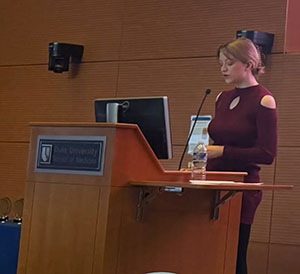
Her lab’s research shows that in metastatic melanoma cells, IMPDH2 is modified in a way that acts like an on/off switch, and another protein called alpha-tubulin N-acetyltransferase 1
(ATAT1) helps make this happen. This discovery reveals a new way melanoma cells regulate energy production. Understanding this process could lead to new treatment strategies to stop melanoma from spreading.
Weidenhammer is part of the DCI Cancer Biology Program and a member of the Nikiforov Lab.