

After decades of service to Duke Pathology, William “Bill” Bradford, MD, and Victor L. Roggli, MD, retired on June 30, 2026, closing two extraordinary careers defined by leadership, discovery, and mentorship. Though their paths differed—one rooted in medical education, the other in scientific advancement—both have left an enduring imprint on the department and the field of pathology.
“Drs. Bill Bradford and Victor Roggli have both served in the Department of Pathology at Duke University for decades and have been exemplary members of our faculty,” said Johnston-West Endowed Department Chair of Pathology Jiaoti Huang, MD, PhD. “As they approach retirement, we celebrate their remarkable careers and lasting contributions.”
Building the Foundation: Dr. Bill Bradford’s Legacy in Education
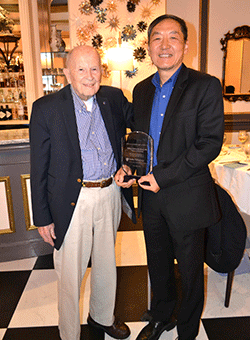
Bradford’s six-decade career at Duke has been defined by an unwavering commitment to teaching and training the next generation of pathologists. He began his career at Duke in 1965 as a research fellow in pathology and ultimately became a central figure in the Duke Pathology Department’s educational mission, serving for decades as director of its Residency Program.
In this role, he helped shape the structure, rigor, and national reputation of the program. He guided residents through demanding clinical training while instilling the values of professionalism, integrity, and lifelong learning. For many trainees, Bradford was not only a program director, but a defining mentor whose influence shaped their careers.
His leadership extended beyond the department, including multiple terms as associate dean for medical education and contributions to admissions and institutional leadership. Widely respected for his clarity and accessibility, he earned numerous teaching honors, including multiple Golden Apple Awards and the Distinguished Teacher Award from the Duke Medical Alumni Association.
A longstanding tradition within the residency program, the William D. Bradford Resident Teaching Award recognizes Duke Pathology residents or fellows who, in the opinion of the Pathology residents, have distinguished themselves in teaching effort and ability. It is awarded each year at the graduation ceremony. The 2026 awardee is John Yablonski, MD.
At the heart of his legacy is a lasting, meaningful impact: generations of physicians whose careers were shaped by his steady leadership and dedication to education.
“This has been a great opportunity to be at Duke—great friends, great people, a great program—and I truly couldn’t have been in a better place. I want to thank everyone who has helped me; I couldn’t have done any of this without you.”
Advancing Understanding of Occupational Lung Diseases: Dr. Victor Roggli’s Global Impact

Since joining Duke in 1980, Roggli has become one of the world’s leading experts in pulmonary pathology, with a career focused on occupational lung diseases such as pneumoconiosis and mesothelioma.
His research has played a pivotal role in advancing understanding of how inhaled toxins—particularly asbestos—affect human health. Through innovative use of electron microscopy and decades of investigation, his work has influenced scientific knowledge, workplace safety standards, and clinical practice. Roggli’s work has helped define how the medical community understands asbestos-related disease and how that knowledge translates to clinical care and public health.
A prolific scholar, he has authored more than 250 peer-reviewed publications and contributed to over 40 books, including Pathology of Asbestos-Associated Diseases, considered a definitive reference in the field.
Beyond academia, Roggli has spent more than 35 years serving as an expert witness in asbestos-related cases, helping transform complex pathology into clear, evidence-based testimony for juries nationwide.
He is committed to paying it forward, so in support of education in his field, he has used some of his medical-legal funding to support a pulmonary pathology fellowship at Duke. The first fellow, in 1996, was Tim D. Oury, MD, PhD, (now at the University of Pittsburgh), followed in 1997 by Duke Pathology Adjunct Associate Professor Thomas A. Sporn, MD, (now at East Carolina University). Since then, he has helped train five additional pulmonary pathology fellows.
“I really appreciate all the opportunities and how fortunate I was to learn from great teachers and many other individuals here,” said Roggli.
Mentorship and Lasting Influence
For both physicians, mentorship has been central to their work.

Bradford shaped generations of residents through structured training and personal guidance, while Roggli trained fellows and supported the growth of pulmonary pathology through both teaching and philanthropic investment in fellowship education.
Together, their legacies are reflected not only in programs and publications, but also in the people they have trained.
Roggli’s leadership has also extended to the broader field, including his role as a founding member and president of the Pulmonary Pathology Society, where he helped shape the direction of thoracic pathology worldwide.
A Shared Legacy
Together, Bradford and Roggli represent two pillars of Duke Pathology’s mission: the strength of its educational programs and the advancement of scientific knowledge. As they retire, their influence remains woven into the fabric of the department, particularly in the trainees they have mentored, the programs they have strengthened, and the discoveries they have advanced.
Their combined legacy will continue to shape Duke Pathology and generations of pathologists to come.
On June 10, 2026, Duke Pathology hosted a dinner in celebration of their retirement. Several department members gave remarks:
Senior Vice Chair David N. Howell, MD, PhD:
“I’ve known Victor for more than 4 decades. When I came to Duke and joined our Residency Program, at the invitation and urging of Bill Bradford, Victor was already on the faculty, and we’ve worked together since 1984, both at Duke and at the Durham Veterans Hospital. I really, really enjoy working with him and see him as a mentor figure. It’s been a great honor to work with him. He’s a wonderful pathologist, but I think of him first and foremost as a teacher, and he’s been one of my favorite teachers. Also, he’s a person of an indomitable spirit.
Howell shared a limerick that he wrote to celebrate Dr. Roggli’s 50th birthday:
Said a poet, his eyes wild and goggly,
“I can’t sleep, and my mind is all boggly.
I stayed up half the night,
And yet, try as I might,
I can’t think of a word rhymed with Roggli.”
Residency Program Director Thomas J. Cummings, MD:
“Dr. Bradford was my Residency Program director. I learned a ton from him. His enthusiasm and loyalty are second to none, and I could not have envisioned a more meaningful residency, neuropathology fellowship, or career than the one I found at Duke.
I’m reminded of that same commitment in Dr. Roggli. At the 2025 Duke Pathology Scientific Retreat, after receiving an award, his first words were an invitation, encouraging any resident interested in contributing to his upcoming book chapter to reach out. That moment perfectly captures his dedication to education, mentorship, and putting others first.”
Professor of Pathology Raj Dash, MD, FCAP
“Dr. Bradford did something very special for me–he organized a fifth year for me around informatics. He put a tremendous amount of effort into working with the American Board of Pathology to allow me to have a fellowship year in informatics when it didn’t exist yet in 2000. I’m very appreciative of how he shaped my career.”
Assistant Professor of Pathology Huihua Li, MD, PhD:
“I am deeply grateful for Dr. Roggli’s mentorship. He is consistently supportive, optimistic, and always there for us when we need him. Every single day, he comes in with boundless energy and a bright smile. Whether leading discussions on challenging cases at the consensus conference or listening to country music while working in his office, his presence is always uplifting. As a survivor of cystic fibrosis, his passion for research is truly inspiring; he remains genuinely thrilled by new research findings and frequently works on manuscripts over the weekend. He is a true role model who taught me not just how to become an outstanding pathologist, but how to be a kind person. He is an interesting individual (including his love for karaoke!). I feel very fortunate to have had the chance to work with him and learn from his remarkable legacy.”
Associate Professor of Pathology Giselle López, MD, PhD:
Speaking of Dr.Roggli, she said, “He came every single week to help us get through that first year of medical school. He’s worn many hats and has been with me through all of this as I discovered a love of pathology.”