
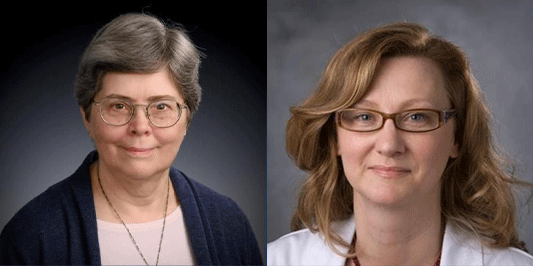
On April 1, 2026, Professor of Pathology Laura Hale, MD, PhD, and Assistant Professor in Surgery Dawn Bowles, PhD, were awarded funding for work that, if successful, could help cancer patients regain immune function more quickly after cultured thymus tissue implantation (CTTI), reduce transplant rejection by promoting immune tolerance, enhance treatments for autoimmune disease, and support healthier immune systems as people age.
The two-year exploratory R21 grant ($275,000 direct costs) from the National Institutes of Health (NIH) will support the co-principal investigators' project, titled “Speeding Immune Reconstitution after Thymus Transplantation.”
Together, Hale brings deep expertise in thymus biology, and Bowles contributes specialized knowledge in gene therapy. Professor of Surgery Joseph Turek, MD, PhD, MBA, is also on the research team, which has dedicated the last five years to studying thymus transplantation-related projects.
CTTI, also called thymus transplantation, is a U.S. Food and Drug Administration (FDA)-approved curative treatment for congenital absence of a thymus, a condition known as congenital athymia. It was developed at Duke in the 1990s by a team led by Professor Emeritus of Pediatrics Mary Louise Markert, MD, PhD. Prior to the development of CTTI, 100% of babies born with congenital athymia died of infection. Now 77% of athymic patients treated by CTTI can fight off infections and survive long-term.
After CTTI, it typically takes six to twelve months for the transplanted thymus tissue to produce enough new T cells to protect patients from infections. During this early period, before a functioning immune system is fully established, patients are especially vulnerable. As a result, the most common cause of death after CTTI is a serious infection that occurs before adequate immune protection has developed.
Therefore, there is an urgent need to develop therapies that can speed up T cell production. Faster immune reconstitution could help prevent these early, potentially preventable infections, improve survival, and allow more patients to benefit from the treatment, which restores immune function and promotes long‑term immune tolerance.
The thymus plays a critical role in immune development. In healthy individuals, it grows rapidly before birth and during early infancy when it produces large numbers of T cells. Thymus size is closely linked to the number of T cells the body can make. In CTTI, physicians implant only a small amount of thymus tissue, which is much less than the amount normally present in healthy infants and children. This limited tissue contributes to the slower pace of immune development, highlighting the importance of strategies that can enhance T cell production and strengthen immune protection sooner.
By studying mouse and human thymus tissue at the single‑cell level, Hale’s team uncovered several key biological pathways that control how the thymus grows early in life and why it slows down and shrinks later. These discoveries revealed new opportunities to “tune” thymus growth safely.
With this new funding, the team will test innovative approaches to help the thymus grow and function more effectively after transplantation. Using gene therapy, they will activate a pathway that encourages thymus growth. At the same time, they will use medications to turn off another pathway that normally suppresses thymus growth. Together, these strategies are predicted to help the thymus produce protective T cells more quickly.
This work will be studied in mouse models of congenital athymia and in human thymus tissue maintained in the laboratory as thymic slice organoids, which mimic how the thymus behaves in the body. The key measure of success will be how fast patients can build a healthy supply of T cells after thymus transplantation, which is a critical factor in shielding them from life‑threatening infections.
The research team is uniquely prepared to carry out this work, bringing together deep expertise in thymus biology, gene therapy, and CTTI in both animal models and human patients.
If successful, these advances could help cancer patients recover immune function faster following CTTI by improving immune recovery after therapy, support safer organ transplantation by promoting immune tolerance, improve the treatment of autoimmune diseases, and boost immune health as people age.