
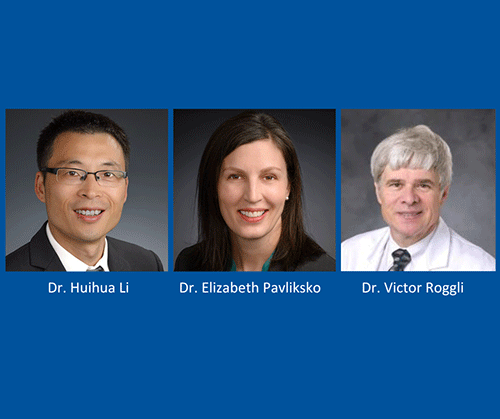
Duke’s Thoracic Pathology team has led the largest comprehensive study to date examining the development of mesothelioma in transplant recipients. The study, “Development of Mesothelioma in Organ Transplant Recipients: A Comprehensive Study of 10 Cases,” was published in Archives of Pathology & Laboratory Medicine on May 11, 2026.
Assistant Professor Huihua Li, MD, PhD, served as first author, with Professors Victor Roggli, MD, and Elizabeth Pavlisko, MD, as senior authors. The multi-institutional collaboration included partners from the United States, Australia, and the United Kingdom, with Duke contributing eight of the ten cases analyzed.
Mesothelioma is a rare, aggressive cancer that arises from the lining of organs such as the lungs (pleura) and abdomen (peritoneum). It accounts for about two percent of all cancers. Its occurrence in transplant patients is even rarer and not well understood. This study examined 10 male patients, ages 57–77, who developed mesothelioma following kidney (3), liver (3), heart (2), lung (1), or bone marrow (1) transplants.
In this study, the time interval between transplant and development of mesothelioma ranged from 1.1 to 23 years, with patients who underwent bone marrow and kidney transplants appearing to have longer intervals (medians, 23 and 8 years, respectively). Subtypes of mesothelioma observed included epithelioid (3), biphasic (3), and sarcomatoid (4). No clear link was found between the type of transplanted organ and the subtype of mesothelioma. Compared with the general population, more aggressive subtypes of mesothelioma—sarcomatoid and biphasic—were seen more frequently. The study participants survived a median of 10.5 months after diagnosis of mesothelioma, with epithelioid cases associated with better prognosis. The researchers concluded that mesothelioma, although rare, represents another malignancy occurring in the post-transplant population, emphasizing the importance of immune surveillance in cancer development.
Additional contributors from Duke Pathology included John M. Carney, MD, Carolyn H. Glass, MD, PhD, and former Duke Pathology members Sergio Pina-Oviedo, MD, (Houston Methodist Hospital) and Thomas A. Sporn, MD, (East Carolina University). Collaborating institutions include the University of California Los Angeles (Andre E. Nel, MD, PhD), University of Chicago (Aliya N. Husain, MD), Flinders University in Australia (Sonja Kebe, MD), and Cardiff University in the United Kingdom (Richard Attanoos, MD).