
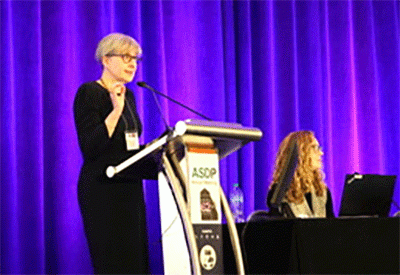
Duke’s Dermatopathology Division had a strong presence at the American Society of Dermatopathology (ASDP) 62nd Annual Meeting Nov. 6-9, 2025, in Baltimore, MD.

Professor Maria Angelica Selim, MD, taught in the short Course I, titled “On the Margins of Dermatopathology: Examining Edges That Matter.” The course aimed to strengthen diagnostic skills, improve patient care, and expand expertise in conditions affecting mucosal surfaces, including the eyes, mouth, and genital areas. Selim spoke about vulvar precursor lesions, an area of growing importance as dermatopathologists increasingly are called upon to diagnose non-human papillomavirus (HPV)-related vulvar dysplasia. The presentation covered how these cases are classified, their key microscopic features, and the diagnostic tools available to support accurate evaluation.

Also, Selim led a virtual session called “Interesting Cases in Vulvar Pathology,” which explored a range of conditions affecting the vulva. The discussion highlighted how these cases present clinically, what to look for under the microscope, and when additional tests can help. Using real-case examples, she covered a broad spectrum of issues, ranging from inflammatory disorders to gland-related conditions and tumors that impact women of various ages.
During the Oral Abstract Session, Assistant Professor Jennifer Crimmins, MD, Assistant Professor Michelle Schneider, MB, BCh, BAO, and Duke Pathology resident Jarvis Williams, MD, PGY2, collaborated to present an unusual case report titled “Histopathologic Features of Acute Chikungunya Virus infection: A Case Report of a Returning International Traveler in North Carolina.

Chikungunya virus is a mosquito-borne alphavirus that typically causes acute infection, characterized by the abrupt onset of fever, pain in multiple joints, sore throat, conjunctivitis, and cutaneous manifestations, most commonly presenting as a maculopapular rash.”
Recognition of these histopathologic features, particularly in returning international travelers, may prompt consideration of additional laboratory testing and expand the documented spectrum of chikungunya-associated histopathology.
Schneider also participated in the Dermatopathology Training Directors Meeting and Meet the Directors Program, where residents had the chance to meet dermatopathology program training directors from across the country.
Assistant Professor Eric Morgan, MD, attended as well and was elected to serve on the ASDP Ethics Committee.
The meeting included a poster presentation, which featured the following Duke authors and collaborators:

- “Low-grade Mesenchymal Neoplasm with Novel THBS1:ERBB2 Fusion Arising from the Labia,” Ashley Rose S Loew, MD, MSc, Shakira Harding, MD, Nicole Kerner, MD, Carlos Prieto-Granada, MD, William Jeck, MD, Maria Angelica Selim, MD, and Eric Morgan, MD
- “Basal Cell Carcinoma in a 20-Year Institutional Review,” Ashley Rose S Loew, MD, MSc, Jennifer Crimmins, MD, Maria Angelica Selim, MD, and Michelle Schneider, MD
- “Histomorphologic Variability of Cutaneous Intralymphatic Histiocytosis: Insights from Cases and Literature Review,” David Walker Phillips, MD, Jennifer Crimmins, MD, Maria Angelica Selim, MD, and Eric E Morgan, MD
- “Histopathologic Features of Macrophage Activation Syndrome: A Case Report of Coagulopathy in the Setting of Adult-Onset Still’s Disease,” Jarvis Williams, MD, and Michelle Schneider, MD
- Lymphoplasmacytic Plaque in Children: Report of a Case,” Harrison Dai, MD, Hernán Correa, MD, and Carlos Prieto-Granada, MD
- “Agreement Rates for Outside Diagnoses of Melanocytic Lesions,” Olivia J Leung, MD, Xiaowei Xu, MD, PhD, Eric E Morgan, MD, and David E Elder, MBChB