
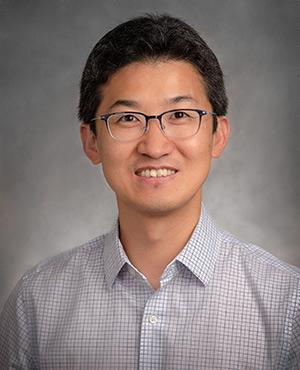
Assistant Professor Jung Wook Park, PhD, delivered a talk about an early warning marker for neuroendocrine prostate cancer (NEPC) at the Society for Basic Urologic Research (SBUR) Annual Meeting in Orlando, Florida, Nov. 13-16, 2025.
Prostate cancer can become much harder to treat when it evolves into the rare but aggressive form of NEPC. This often happens after patients receive the drug enzalutamide. However, the way this dangerous change happens is not well understood.
In his talk titled “NPTX1 as an Early Driver of Lineage Transformation Toward Neuroendocrine Prostate Cancer,” he discussed his lab’s discovery that a protein called NPTX1 (Neuronal pentraxin-1) plays a central role in this transition.
“We found that NPTX1 levels rise early in prostate cancer cells that become resistant to treatment, and it is highly elevated in NEPC patient tumors,” said Park. “Increasing NPTX1 in prostate cells pushed them toward aggressive, neuroendocrine-like behavior, while removing NPTX1 prevented this transformation, slowed tumor growth, and spread. We also uncovered how NPTX1 drives this change through a chain reaction involving two other proteins, REST (repressor element 1 silencing transcription factor, and HDAC6 (Histone Deacetylase 6). Blocking HDAC6, using genetic tools or drugs, slowed tumor growth and reduced cancer cell aggressiveness.”
Park’s findings suggest that NPTX1 could serve as an early warning marker for NEPC, and that targeting HDAC6 may offer a new treatment strategy for patients whose prostate cancer becomes resistant to standard therapies.
Park holds an Endowed Rollie Assistant Professorship in Correlative Pathology and has received various other awards, including the following:
- Class of 2020 Young Investigator Award from the Prostate Cancer Foundation (PCF)
- DOD Prostate Cancer Early Hypothesis Development Award (2025)
- DOD Prostate Cancer Idea Development Award (2024)
- DOD Prostate Cancer Idea Development Award (2021)
- DOD Kidney Cancer Idea Development Grant (2022)
Learn more about the Park Lab here.