
Shining a Spotlight on Dr. Victor Roggli: Cystic Fibrosis Survivor, Expert Asbestos-Related Diseases Witness, Karaoke Star
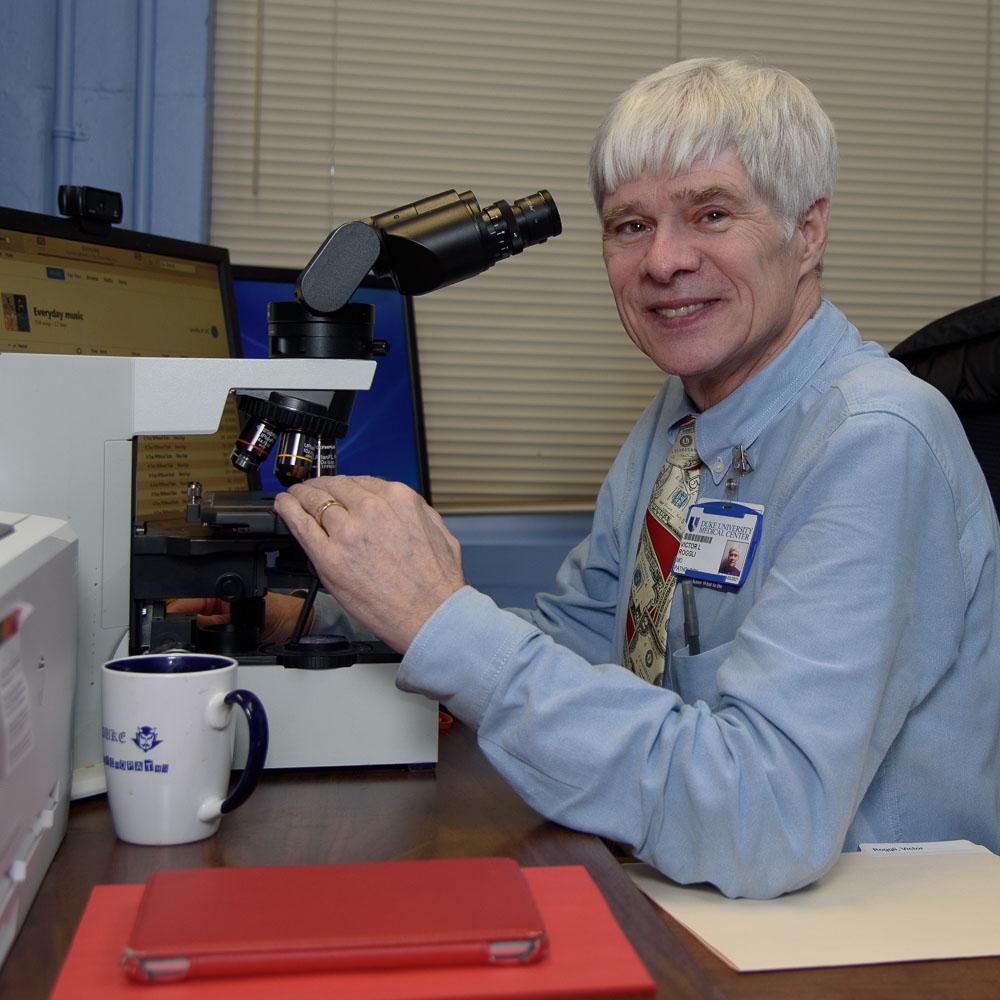
Victor Louis Roggli, MD, is one of the world’s leading pulmonary pathologists with expertise in pneumoconiosis — a group of lung diseases caused by the lung's reaction inhaling certain dusts — and mesothelioma, a tumor of the tissue that lines the lungs, stomach, heart, and other organs. He has spent over 35 years testifying in jury trials as an expert witness in cases of asbestos-related diseases. He has published more than 240 peer-reviewed articles and contributed chapters to 40 books. He is the author of “Pathology of Asbestos-Associated Diseases” and four other medical books.
His world-renowned work in the pathology of occupational lung diseases has paved the way to better understanding of disease processes related to occupational and environmental exposures to toxins like asbestos. He is in the 44th year of his career, and he wasn’t even supposed to live past the age of 12.
Early Childhood
Roggli grew up on his grandfather’s farm in Cowan, Tennessee, along with his brother and two sisters. His battle with chronic illness began when he was seven years old, when he came down with the measles, then mumps, followed by double pneumonia. For the next five years, he had a chronic cough and was unable to gain weight. He was diagnosed with cystic fibrosis (CF), an inherited disease primarily affecting the pancreas and lungs. His doctor had never seen a patient with CF who had lived to be 12 years old, much less one who presented symptoms at that age.
“From that day forward, things would never be the same for me, as my life became forever intertwined with a maze of medications that had to be taken daily,” recalled Roggli. “Along with these medications came my introduction to the Bennett AP-5, affectionately known as the Bennett bird. The bird was a blue-gray apparatus for nebulizing medications for inhalation and was bigger than a breadbox, weighing in at 10 or 15 pounds. Wherever I went, the bird went along, too!”
Career
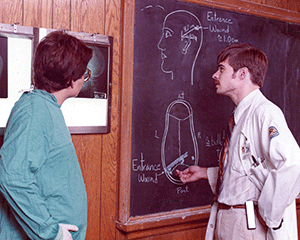
With the help of the bird and his medications, he confounded his initial doctor’s expectations and went on to attend high school at Sewanee Military Academy, a subsidiary of the University of the South, where doctors closely monitored his health. He met the physical demands of military school and graduated in 1969. He entered Rice University that fall, with hopes of becoming an aerospace engineer.
“If my affliction with CF was to keep me from being an astronaut, maybe I could be one of the guys on the ground who made sure that the astronauts blasted into space and returned to earth safe and sound,” recalled Roggli.
By the close of his freshman year, a sharp cut in NASA funding had raised hurdles to a career in aerospace engineering, and he changed his major to biochemistry. He graduated summa cum laude from Rice in May of 1973, and began applying to medical schools. At 22 years of age, he was accepted to Baylor College of Medicine.
“As a child with cystic fibrosis, I had never dreamed of becoming a doctor. My prior encounters with physicians had even left me somewhat fearful of them,” said Roggli. “In medical school, I learned now that patients with CF rarely lived beyond 30 years of age."
"This came from Nelson’s textbook on pediatrics, a well-respected text used in major medical schools such as Baylor College of Medicine to teach medical students about the discipline of pediatrics. Why would someone write it if it were not true? I was depressed for several days after reading this. Part of what drove me on ahead was the typical teenage belief that the statistics don’t apply to me. Part of it was my Grandmother Patton telling me that I would have to use my brain to make a living. But everything that I did was colored by the uncertainty of what lay ahead for me.”
In medical school, his favorite course was pathology, and he relished learning about the effects of disease on organs and tissues. He was awarded the Stuart A. Wallace Award for his position as the top first-year medical student in the pathology course. He graduated in 1976 with honors.
“Mom and Dad told me how proud they were of me,” said Roggli. “My achievement did not initially register with me, nor the unlikely probability of my success as viewed by the doctors who had cared for me back at Vanderbilt."
"I really didn’t give much thought to the philosophy of taking my life to the highest potential with the full expectation that there would be a tomorrow instead of retreating to a place of safety or security that demanded nothing of me."
"Instead, I plunged ahead as if driven by an unseen force pushing me to the limits of my capacities. I hardly noticed that people now called me Dr. Roggli or that I could sign “MD” after my name. I felt like I was the same person who, just days before, was merely a senior medical student. But I was always hungry to learn more!”
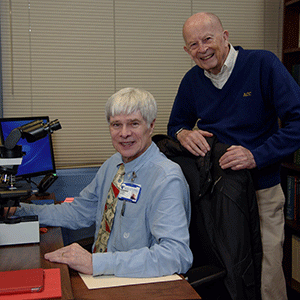
Roggli began his residency in pathology at Baylor Affiliated Hospitals in Texas from 1976-1980.
One of his first cases as a resident had “an incalculable and indelible effect on my medical career,” he recalled. To everyone’s surprise, the autopsy of a liver cancer patient revealed instead a rare cancer of the abdominal cavity's lining: malignant peritoneal mesothelioma. Roggli’s mentor at the time, Malcolm McGavran, MD, Professor of Pathology, knew from articles published in the literature (with the critical initial observations made by Dr. John Christopher Wagner, MBBCh, a pathologist in South Africa) that these cancers may be caused by asbestos. So, he suggested that Roggli use a relatively new test to look for asbestos in the patient’s lungs.
Using a simple test involving dissolving small portions of lung tissue in bleach, then examining the filtered results under a microscope, Roggli discovered that indeed there were asbestos bodies present. This sparked his curiosity about asbestos and the diseases it causes. For the next two years, he began collecting all the information he could and participated in various studies of the asbestos content of the lungs of asbestos workers and other patients diagnosed with mesothelioma. It would become the focus of his career.
He was elected chief resident during his final two years of training at Baylor, and became skilled in using the electron microscope — a powerful instrument that magnified tiny asbestos particles that are otherwise invisible to the human eye.
Following Baylor, he searched for institutions with renowned pulmonary pathologists, and discovered Philip C. Pratt, MD, a well-known pulmonary pathologist who was a professor at Duke University Medical Center and the chief of the laboratory at the Veterans Affairs (VA) Medical Center in Durham. He accepted a position at the VA Medical Center in July of 1980, and was named an assistant professor at Duke University School of Medicine in 1981. After seven years on the faculty, he was promoted to associate professor of pathology at Duke with tenure. In 1994, after 14 years on the faculty, 87 peer-reviewed publications, 12 chapters in textbooks, and serving as editor of two textbooks, he was promoted to full professor of pathology at Duke. He became instructor of Duke’s Systemic Pathology course and Pulmonary Pathology course, a position he still holds today.
Shifting Focus to Legal Cases
Between 1972 and 1992, the Occupational Safety and Health Administration (OSHA) created regulations for permissible asbestos exposure limits, requiring that employers establish regulated areas, control work practices, and institute engineering controls to reduce airborne levels. These regulations ultimately influenced Roggli’s career.
In 1981, he was asked to do an analysis on the case of a man in his early 30s with mesothelioma who had worked in a shipyard with asbestos present. It was the first legal case Roggli was involved in. It would be far from the last.
After the publication in 1986 of his article “Asbestos Content of Lung Tissue in Asbestos-Associated Diseases: A Study of 110 Cases,”[1] Roggli began receiving lots of requests to review legal cases, mostly for plaintiffs but some for defendants as well. His reports included references from numerous sources, and he thought it would be useful to gather the information in one place. So he contacted Pratt and another mentor, S. Donald Greenberg, MD, about collaborating to write a book on asbestos-related diseases. After working together on it for five years, in 1992 the first edition of “Pathology of Asbestos-Associated Diseases” was published by Little, Brown and Co.
In April 1987, W.T. Elliott McCaughey, MD, invited Roggli to become a member of the U.S.-Canadian Mesothelioma Panel. At the time, the panel had 32 cases, and today it has over 3,500 cases. He published the fourth edition of his book, “Pathology of Asbestos-Associated Diseases,” in September 2025, and donated a copy to the Pathology Department’s library.
Currently, he is writing his autobiography, “So Far, So Good.” Plus, in 2025 he received a contract from Springer to produce a volume titled “Mesothelioma in the 21st Century,” which he is editing along with Duke Pathology Professor Elizabeth Pavlisko, MD, and Pathology Professor Tim Oury, MD, PhD, at the University of Pittsburgh.
Awards and Lectures
In April of 2020, Roggli received the prestigious Pulmonary Pathology Society (PPS) Lifetime Achievement Award, in recognition of his outstanding clinical and academic contributions to the field of thoracic pathology and his service to the PPS. He was honored for contributing to the pulmonary pathology community through his leadership, vision, and mentoring. He was a founding member of the society and also served as president from 2000-2002.
Over his career, Roggli has lectured on all aspects of lung diseases. A recent highlight is his presentation at the Pulmonary Pathology Society Biennial meeting in Cork, Ireland, on June 25, 2022, titled “Mesothelioma and Occupational Lung Disease — Pitfalls for Expert Witnesses.”
What Comes Next and Why it Involves Karaoke

Roggli is committed to paying it forward, so in support of education in his field, he has used some of his medical-legal funding to support a pulmonary pathology fellowship at Duke. The first fellow, in 1996, was Tim D. Oury, MD, PhD, (now at University of Pittsburgh) followed in 1997 by Duke Pathology Adjunct Associate Professor Thomas A. Sporn, MD, (now at East Carolina University). Since then, he has helped train five additional pulmonary pathology fellows.
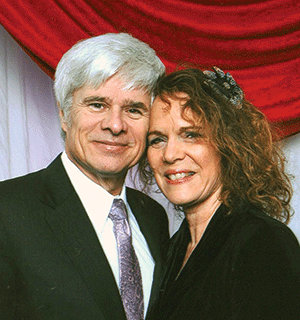
Roggli believes that a strong diaphragm has been key to his survival, and he is a member of an online CF seniors group that consists of many singers and marathon runners. He and his wife of 33 years, Linda Roggli, regularly host karaoke parties at their home. He won his first local karaoke contest by performing Aerosmith’s “Dream On.”
Current statistics show that the average age of the 30,000 or so individuals with CF is 36. Clinics have sprung up around the country for treating adults with CF. It is no longer a disease treated only by pediatricians and new treatments are being developed and tested every day.
In his free time, he and Linda work with individuals who have Attention Deficit Hyperactive Disorder (ADHD). Since 2012, they have dedicated their time to ADHD couples retreats and coaching. Linda is a professional certified Coach, an award-winning author, and founder of the A-D-Diva Network.
Roggli’s success is based upon his deep belief in living to the fullest in the present moment.
“The most pervasive effect on my life of living with the knowledge of having a fatal disease was the tendency to live every day as if it were literally my last,” said Roggli. “That’s not to say that there weren’t days when I was overwhelmingly sad or depressed, wondering why I had to be so different from other people. On the other hand, carpe diem (seize the day) is not a bad philosophy of life, for none of us knows when the end will come. To live every day to its fullest, being thankful for the day at hand, is perhaps the greatest gift that we can give ourselves. How sad it is to think of a life coming to its end that was filled only with yearnings for the past or worries about the future. So, this awareness of the limitations of life and living each day to its fullest is a benefit — a gift, if you will, that I have received from having CF.
[1] Roggli, V. L., Pratt, P. C., & Brody, A. R. (1986). Asbestos content of lung tissue in asbestos-associated diseases: A study of 110 cases. British Journal of Industrial Medicine, 39(1), 18–28.